
Investor Letter Q1 FY27

Dear investors,
Our last quarterly update highlighted our focus on delivering DPI from our early funds. We have been making progress, albeit in a difficult exit market. In July, we sold our stake in EarthAI, returning 12.7x to our Core Fund II from a small cheque. In September, we paid out the proceeds from Procore’s acquisition of DroneDeploy, totalling A$69.8m across Core Fund II, Opportunity Fund II and Opportunity Fund III. We also had two outcomes that were below our expectations - both Expert360 and Zoomo delivered less than the invested capital. We have conducted an internal post-mortem on both to review the original investment thesis, identify the factors contributing to the loss and ensure the resulting lessons are incorporated into our future investment and divestment decision-making. Our Portfolio Committee remains focused on delivering further liquidity across our early fund vintages and we’ll continue to keep you updated on the results.
Looking globally, there have been a few key themes and news moments worth taking note of over the last quarter. Anthropic’s S-1 put hard numbers on the growth and economics behind the AI boom. Capability kept compounding, from long-standing mathematics problems to the software flaws the same models now help find. The market continued to sort software into winners and losers based on the strength of their AI story. And capital concentrated further, into fewer and larger deals with a striking version of the same pattern at home. We cover each below as a follow-on from what we shared at our Investor Summit in October.
The labs open their books
Anthropic’s S-1, filed on 26 October, shows US$16.3bn of revenue in the first half of 2026, up from US$1.2bn a year earlier. This is extraordinary growth at scale, although it is starting to slow from previous quarters.
The filing also puts numbers on one of the year's biggest questions: do open or closed models win? Open-weight models now handle 72% of tokens on OpenRouter, but only 27% of the spend. In the five weeks before the S-1 filing, Anthropic shipped three models, cut prices, and its token usage rose 3.6x on OpenRouter. Its compute costs fell from about two and a half times revenue in early 2025 to under half by mid-2026, leaving room to cut further. Whoever owns the most compute should theoretically be able to serve the cheapest token, so we wouldn’t assume price stays the open models’ advantage forever.
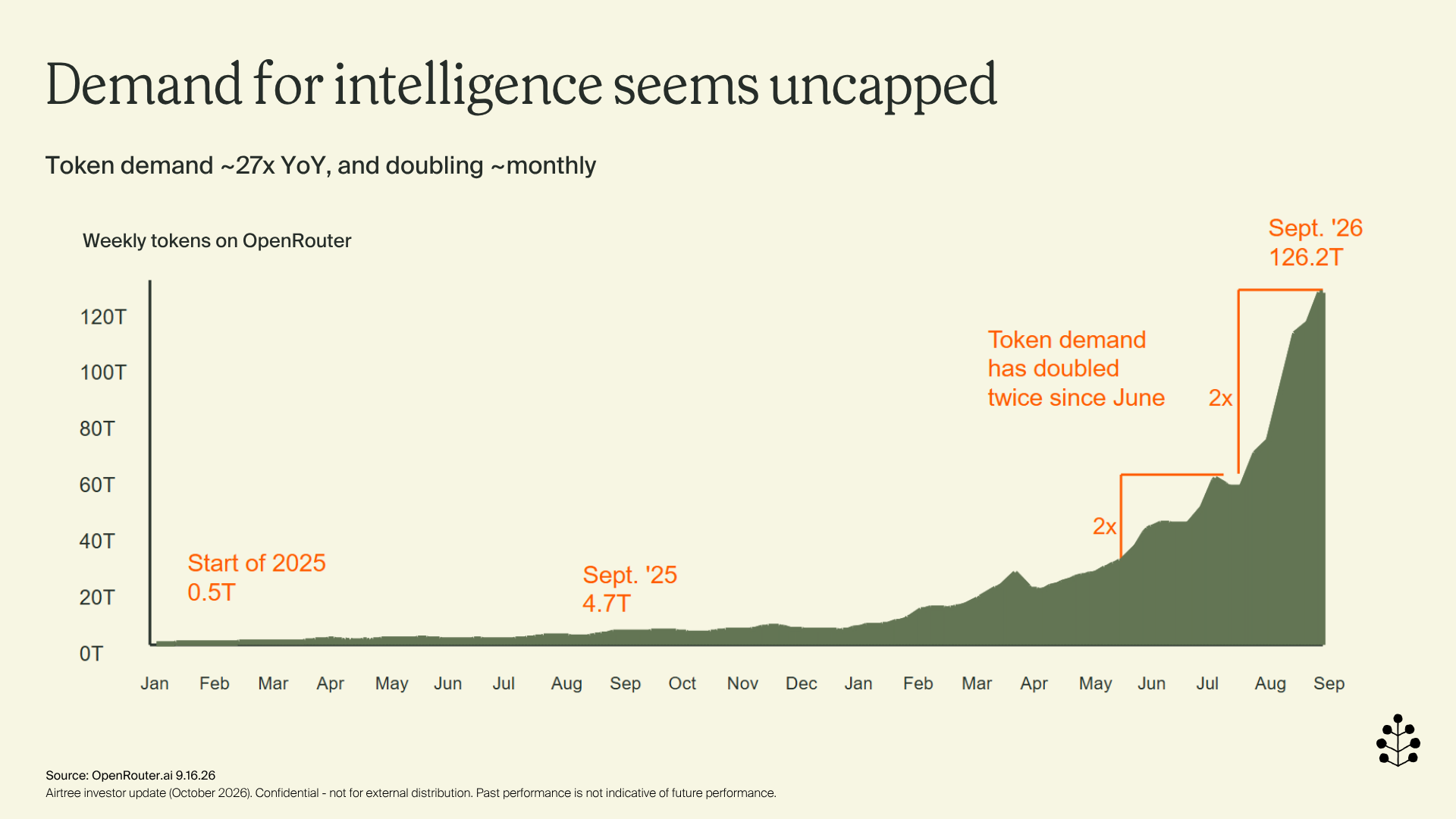
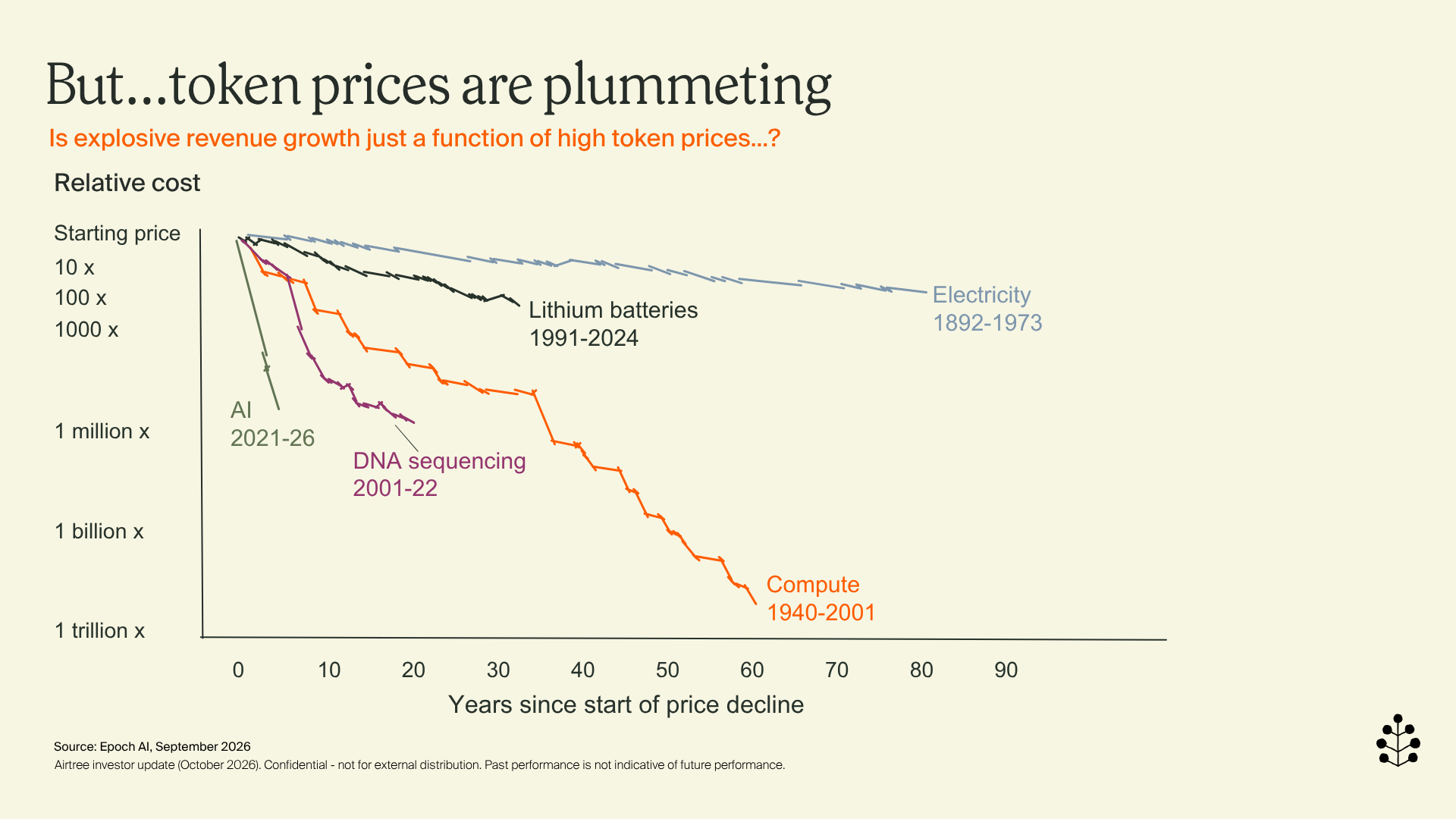
The case for open models comes from a new layer of inference and post-training companies:
- Fireworks went from US$100m to US$1bn of annualised revenue in 16 months.
- Baseten now serves open models to OpenAI’s enterprise customers.
- Stripe agreed to buy OpenRouter for US$7.5bn and NVIDIA agreed to buy Hugging Face for US$12.9bn.
- Thinking Machines Lab, an Airtree portfolio company, gives away its open-weight Inkling models and earns its money fine-tuning them through Tinker. With Bridgewater, it tuned an open model that made about 30% fewer errors than the best closed model on a financial task, at a fourteenth of the inference cost.
- For most of the companies we back, the question doesn’t need a hard-and-fast answer. Many route work across several models, paying for whichever does the job best. We think the long-term value goes to whoever owns the workflow and the customer, regardless of what model sits underneath.
Capability keeps compounding
AI is now cracking long-standing unsolved mathematics problems:
- OpenAI’s internal Astra model solved ten open problems in math and theoretical computer science that had stalled for at least a decade, for about US$2,000 of compute. Each proof was checked in the Lean proof assistant, a program that tests every logical step of a proof mechanically.
- In September, OpenAI said an internal model had solved the Navier-Stokes problem, a famous problem about the equations that describe how fluids move. The Clay Mathematics Institute said the problem has “apparently been settled” and has begun its review.
- Axiom turned the classification of finite simple groups into a form software can verify. That proof is one of the largest in maths, spread across thousands of journal pages and humans have found it hard to check in full.
- An unannounced portfolio company has solved a 65-year-old open mathematics problem and is close to finishing a machine-checked proof of it in Lean. We look forward to sharing more with you once they’ve published.
Because these proofs are machine-checked, AI output in science can now be verified.
The same ability to read and reason through complex material works on software code. AI models helped find serious flaws in PHP, a programming language behind roughly 70% of websites. On 21 October, PHP shipped fixes for these vulnerabilities two days before they were planned for release, due to leaks.
Two days later, a16z’s infrastructure team sent its portfolio CEOs a memo titled “Patch or Die”. It recommends doubling security spend from the typical 10% of the tech budget, holding releases until known vulnerabilities are fixed, and shutting down neglected systems. Last quarter, we said multi-model resilience had become a board topic. Security is now one too and we’re raising it directly with all of our portfolio companies.
Software is being sorted
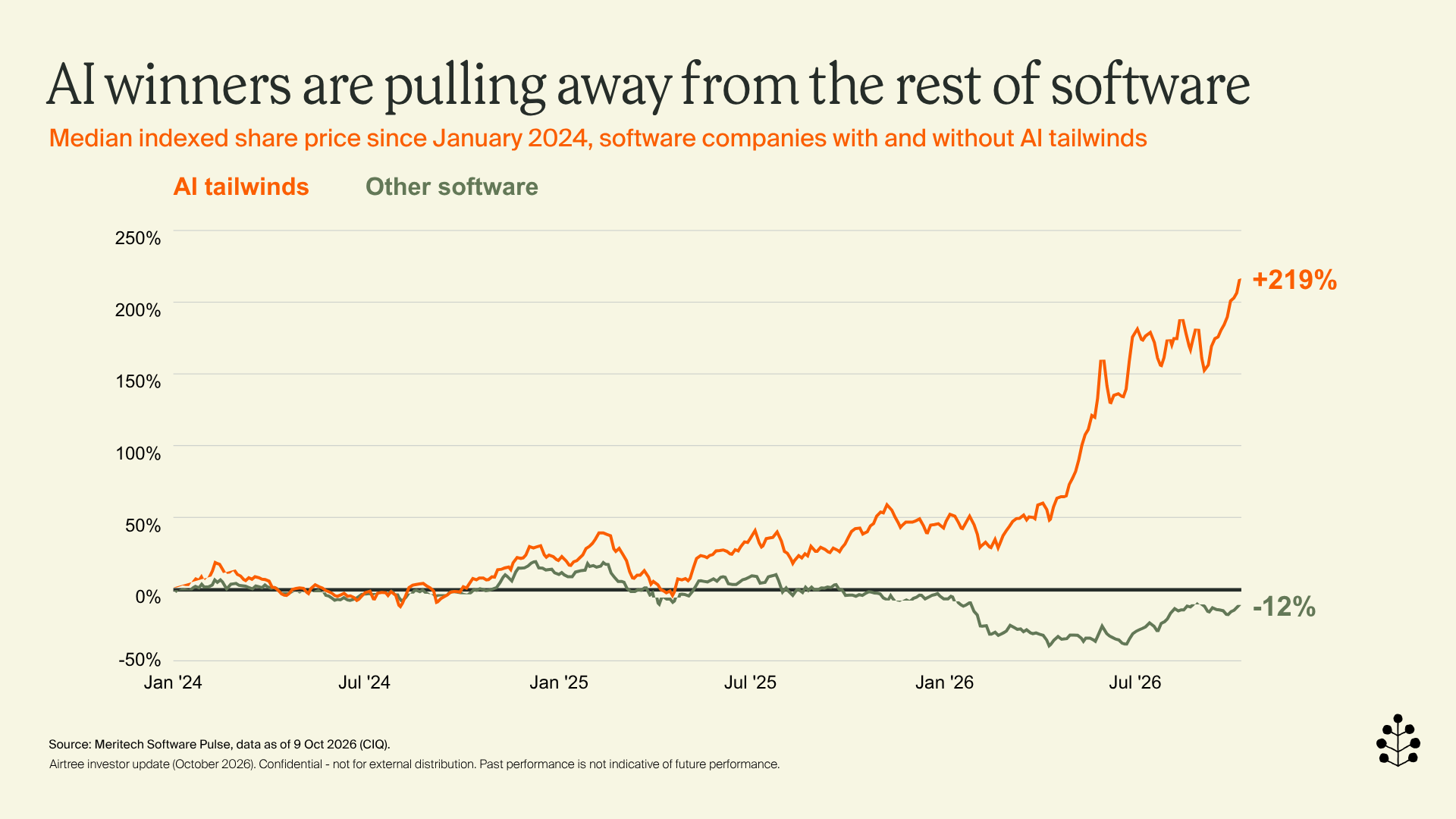
As we wrote last quarter, the market is treating legacy software very differently depending on its AI story. That trend has continued, with a twist: software company share prices have bounced back but the market isn’t paying the same multiples as it used to. Equal-weighted S&P 500 fell 27% to its April low and has since won back about 94% of that fall. Over the same period, its median forward P/E dropped from 26.6x to 16.7x, so they’ve earned their way back rather than being forgiven. The median public SaaS company trades at 4.8x next-twelve-months revenue.
Deals priced at the old highs are now closing well below them. Bending Spoons agreed to buy Miro for US$1.355bn, about 2.3x ARR, against a US$17.5bn valuation in 2022. The market rewards what a model can’t cheaply copy: systems of record, proprietary data, regulated workflows, and usage-based pricing. This has implications (both good and bad) for our more tenured portfolio companies.
What we’re seeing on home ground and abroad
Globally, venture is a story of more money in fewer deals. 2026 Q3 funding hit US$159bn, with AI taking 64% and a record 27 rounds of US$1bn or more. Australia has the same shape, just on a smaller scale. Cut Through Ventures counts a record $4.2bn raised in Q3, but two-thirds of it was Firmus, whose failed ASX listing has been widely covered in the public domain.
The exit side is thin everywhere and harsher here. Only 18 US venture-backed companies listed in Q3, none of them in AI, and Firmus showed how narrow the door is at home. Listed tech has had a hard year. The ASX All-Tech index fell 33.9% over 12 months while the NASDAQ rose 18.5%. The median ANZ SaaS company trades at 2.3x revenue, against 7.1x a year ago, which is the yardstick our later-stage companies are being measured against.
The Reserve Bank of Australia lifted the cash rate to 4.85%, its fifth increase this year. In its October Financial Stability Review, the RBA put AI at the centre of global risk. A handful of AI-exposed firms are driving equity markets and their prices assume strong adoption and profits. The RBA’s concern is timing: If returns come later or smaller than expected, circular financing, overinvestment and long-dated debt on fast-depreciating hardware could mean losses.
Our policy advocacy continues. The Treasury Laws Amendment (Tax Reform No. 4) Bill 2026 was introduced to parliament in October, with changes to the proposed startup capital gains tax concession, the R&D Tax Incentive and expanded venture capital incentives. The concession would apply from July 2027 to startups up to 15 years old with turnover under A$50m, with a three-year hold and no lifetime cap on eligible gains. Keeping the 50% discount and removing the cap are both moves in the right direction for founders, employees and investors.
The test is still too complex, though, and some of the settings will bite just as companies start to scale. Requiring half of a company’s staff and assets to stay in Australia, or losing the concession, rewards staying small.
As we’ve seen with previous platform shifts, the market is undeniably frothy. Our approach remains to invest consistently through the cycle and return capital from our older vintages as soon as possible.
If you have any questions or feedback, please reach out.



AirTree Ventures Custody Pty Ltd holds AFSL No. 544106.

